Keep Your Dog Safe in Summer Heat: What Actually Works
It was 2:17 p.m. on a Tuesday in Phoenix when a neighbor knocked on my door holding her golden retriever, Biscuit, limp in her arms. She’d taken him for a quick walk — “just around the block” — on asphalt that was sitting at roughly 150°F in direct sun. Biscuit survived. But the vet bill hit $900, and the recovery took almost two weeks. That image stuck with me.
Here’s the part nobody says out loud: most summer heat emergencies in dogs aren’t caused by negligence. They’re caused by miscalibrated instincts. Dog owners underestimate how fast heat accumulates in an animal that can’t sweat through its skin, and they overestimate how well they can read the warning signs in real time. The problem isn’t that people don’t care — it’s that the common advice (“give water,” “walk in the morning”) is too vague to actually prevent the dangerous moments.
This guide is the specific version of that advice.
1. The 7-Second Pavement Test Is Real — and Most People Skip It
Press the back of your hand flat against the pavement for seven seconds. If you can’t hold it there comfortably for the full count, your dog’s paw pads will burn. This is the single fastest field check you can do, costs nothing, and takes less time than clipping a leash. Most people skip it because it feels unnecessary — until it isn’t.
Asphalt absorbs and retains heat far longer than ambient air temperature suggests. On an 85°F day with full sun, pavement can reach 135°F to 145°F. Dog paw pads can sustain burns in under a minute of contact at those temperatures. Concrete runs cooler than asphalt but still climbs well above safe levels in direct afternoon sun. Grass stays significantly cooler — if you have a route option that keeps your dog off pavement, take it after 10 a.m.
The fix is simple: walk before 8 a.m. or after 7 p.m. in July and August if you’re in the South or Southwest. If your schedule doesn’t allow that, stick to shaded trails, grass, or invest in a set of dog booties — they look ridiculous, yes, but they work.
2. Heat Stroke in Dogs Moves Faster Than You Think
A dog can go from panting heavily to non-responsive in under 20 minutes in the right conditions. That’s not a worst-case outlier — that’s a documented progression. The American Veterinary Medical Association (AVMA) has long published guidance on the speed of heat-related illness in dogs, noting that body temperature above 104°F constitutes a heat emergency, and above 106°F causes organ damage that may be irreversible.
The early signs that most owners catch: excessive panting, drooling more than usual, slower movement. The signs people miss: gums that look bright red or pale/white, a dog that suddenly stops wanting to walk and just lies down, vomiting, or a glassy, unfocused look in the eyes. That last one — the glazed expression — is something you only learn to recognize if you’ve seen it before or someone tells you specifically what to look for.
If you see any combination of those late signs, don’t wait to see if the dog improves. Move to shade or AC immediately. Apply cool (not ice cold) water to the paw pads, neck, and armpits. Get in the car with the AC on full blast and call an emergency vet while you’re driving. Do not put ice directly on the dog — rapid temperature drop can cause blood vessels to constrict and make the situation worse.
3. Cars Are the Fastest Kill — and the ‘Cracked Window’ Myth Needs to Die
A cracked window does almost nothing. Studies measuring interior car temperature with windows cracked one to two inches found that the cabin still reaches dangerous temperatures within minutes on a warm day. On an 80°F day with sun, the interior of a parked car can hit 99°F in 10 minutes and 114°F in 30 minutes. A dog left in that environment is not “just for a minute” — it’s a crisis waiting to happen.
This isn’t about guilt-tripping anyone. It’s about being honest that the mental model most people carry (“the window is cracked, it’s fine”) is factually wrong. If you’re running into a store and you can’t bring your dog, leave your dog at home. Full stop. No errand is worth the risk, and parking in shade provides only marginal protection — shade shifts, clouds move, and the car still heats up.
Several states have laws that allow bystanders or law enforcement to break a car window to rescue an animal in distress. If you see a dog in a hot car, note the time, check for signs of distress, and call 911. Don’t wait for the owner to return.
4. Water Access: More Specific Than “Make Sure They Have Water”
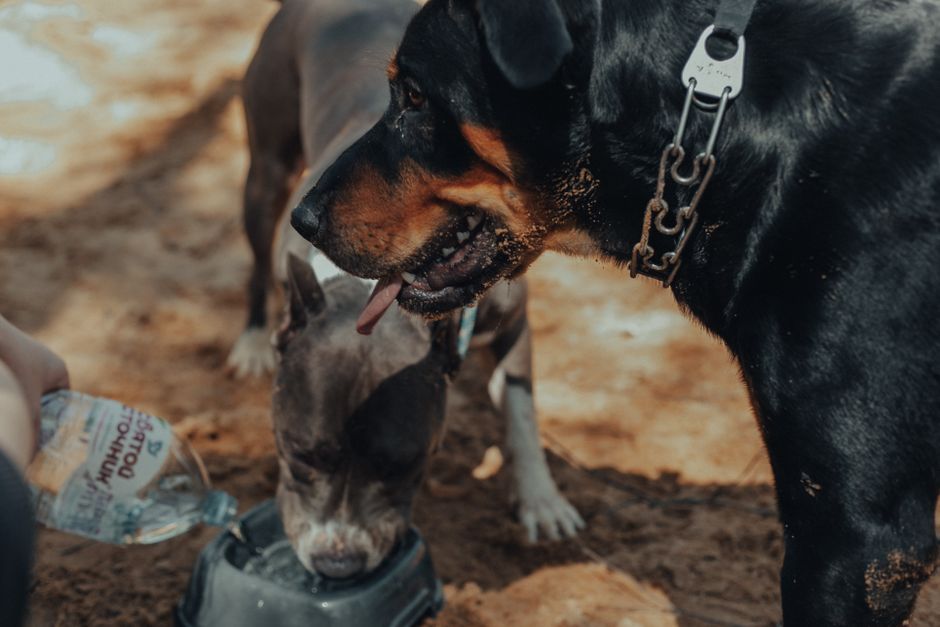
Dogs on a walk in summer heat need water every 15 to 20 minutes in hot conditions — not just before and after. A collapsible silicone water bowl weighs almost nothing and fits in a back pocket. Carry one. Carry a full water bottle dedicated to the dog. This is not optional gear in a heat wave.
At home, the bowl placement matters more than people realize. A metal bowl sitting in direct afternoon sun will heat the water to a temperature that discourages drinking. Move it to shade, or switch to a ceramic or insulated bowl. Some dogs will drink significantly less if the water is warm — and a dog that’s already warm and dehydrated is a dog on a short path to heat exhaustion.
A detail that surprised me the first time I saw it: some dogs are reluctant to drink enough water from a bowl but will enthusiastically drink from a running garden hose or a pet fountain. If your dog is a light drinker during summer, try a recirculating pet water fountain — the movement seems to trigger more interest. It sounds fussy, but it makes a measurable difference for some dogs.
5. Breed and Age Change Everything
A four-year-old Labrador and a seven-year-old English Bulldog are not operating on the same heat tolerance scale. Brachycephalic breeds — dogs with flat or pushed-in faces, like Bulldogs, Pugs, French Bulldogs, Boxers, and Boston Terriers — have a structurally compromised airway that makes panting (their primary cooling mechanism) significantly less efficient. In a heat wave, these dogs are at risk at temperatures and durations that would be fine for a working-breed dog.
The same applies to senior dogs (generally 7 and older for large breeds, 10 and older for small breeds), very young puppies, and dogs with heart or respiratory conditions. If your dog falls into any of these categories, the summer protocol should be stricter: shorter outings, more shade, earlier morning walks, and more frequent vet check-ins during the hottest months.
Overweight dogs also struggle more — the extra body mass generates more heat, and fat tissue doesn’t dissipate heat the way lean tissue does. If your vet has mentioned your dog’s weight, summer is a good time to take that conversation seriously.
6. What a Real “Before and After” Looks Like
A friend in Austin switched from walking her two mixed-breed dogs at 6 p.m. (after work) to 6:15 a.m. starting in May. The morning walks aren’t always convenient — some days she overslept and had to cut it short, and one Thursday she skipped it entirely because of rain — but over three summers, she’s had zero heat incidents. Before the schedule change, she’d had one heat exhaustion scare in June that cost her an emergency vet visit and an afternoon of IV fluids for her older dog.
The imperfect part: on the days she can’t do the morning walk, she does a short five-minute leash-and-sniff in the front yard (which is shaded until 9 a.m.), then gives the dogs 20 minutes of indoor play — a flirt pole in the hallway, a stuffed Kong, some basic training for mental stimulation. It’s not the same as a real walk, and the dogs let her know it. But no one ended up at the emergency vet.
The lesson isn’t “be perfect.” It’s “build a default that’s safe, then have a fallback for when the default fails.”
7. What Doesn’t Work (And Why People Keep Doing It Anyway)
Let’s be direct about four approaches that sound reasonable but consistently fail in practice:
- Relying solely on the dog to “tell you” when it’s too hot. Dogs are motivated to keep up with their owners and can push past their own limits — especially high-drive breeds like Huskies, Malinois, and working Labs. By the time a dog shows obvious distress, the situation has often already escalated.
- Cooling vests as a replacement for shade and water. Cooling vests are a useful supplemental tool, but they require regular re-wetting to stay effective, and they don’t protect paws from pavement burns or address the core issue of ambient heat load. Treat them as one layer of a larger plan, not the plan itself.
- Assuming swimming cools dogs down adequately. A dog swimming in a pool or lake is getting wet, which helps — but the effort of swimming generates body heat, and if the water is warm (which pool and lake water often is in August), the cooling effect is limited. Watch for fatigue, and always rinse pool water off afterward to prevent chemical ingestion during self-grooming.
- Setting up an outdoor fan and calling it sufficient. A fan circulates air but doesn’t lower air temperature. In extreme heat, a fan blowing 95°F air at a dog is not cooling the dog — it may actually accelerate dehydration by increasing respiratory water loss. Shade and water access are non-negotiable; a fan is a supplement, not a substitute.
8. The Indoor Setup That Gets Overlooked
Not every dog owner has central air conditioning — particularly in older homes in the Northeast, where AC is still less universal than in the South and Southwest. If your home doesn’t have AC, the setup matters: keep blinds and curtains closed during peak sun hours (roughly 10 a.m. to 4 p.m.), create airflow with cross-ventilation if possible, and provide a cooling mat — the gel-filled pressure-activated kind that doesn’t require refrigeration works well for most dogs and doesn’t need any setup beyond placing it on the floor.
A damp towel on tile or hardwood is a free alternative. Dogs instinctively seek out cool surfaces, and giving them the option means they’ll use it. Don’t be surprised if your dog ignores the expensive cooling mat and just lies on the bathroom tile — that’s a win too.
Start Here, Today
You don’t need to overhaul your entire summer routine this week. Three small moves that cost almost nothing:
- Do the pavement test before your next walk. Just once. The back of your hand, seven seconds. It takes less time than tying your shoes and it will recalibrate how you think about afternoon walks permanently.
- Put a collapsible water bowl in your regular walking bag or pocket today. Not next week. Today. They cost under $10 at most pet stores and pack flat.
- Move your dog’s water bowl out of direct sun. That’s it. Check where it’s sitting in the afternoon light and move it two feet if needed.
Biscuit, the golden from that Tuesday in Phoenix, is fine now. He’s five years old and apparently still loves walks — just not the 2 p.m. kind. His owner told me she never goes out past 8 a.m. anymore between May and September. Small change. Real consequence. That’s usually how it works.

Publicar comentário