Smart Feeders Stop Overfeeding: What Vets Actually Recommend
My neighbor’s golden retriever, Biscuit, gained nearly 11 pounds in 18 months. Not because of treats. Not because of table scraps. Because his owner — a perfectly responsible person who loves that dog — was eyeballing portions twice a day and assuming it was close enough. It wasn’t. The vet’s exact words were: “He’s eating about 40% more than he should be.”
That conversation happens in veterinary offices across the country every single week. And here’s the part nobody talks about: the problem isn’t that pet owners don’t care — it’s that the tools they’ve been using for decades are fundamentally incompatible with precision feeding. A plastic measuring cup is not a medical device. It never was. When you’re scooping kibble at 6:45 a.m. before your first cup of coffee, you’re not hitting 237 grams. You’re hitting somewhere between “probably fine” and “oops.” Smart feeders exist precisely because that gap — between what we intend to feed and what actually lands in the bowl — is where pet obesity quietly builds.
1. The Measuring Cup Problem Is Bigger Than You Think
Industry surveys have consistently found that a significant portion of domestic cats and dogs in the United States are overweight or obese — some estimates put the figure above 50% of pets seen by veterinarians annually. That’s not a rounding error. That’s a systemic failure of the status quo feeding approach.
The mechanism is simple and almost invisible. Most dry kibble bags instruct owners to feed by volume — “one cup for dogs 20–40 lbs.” But a “cup” of one brand of kibble can contain 350 calories while a “cup” of a denser formula from another brand clocks in at nearly 500. Same measuring cup. Wildly different outcomes. Over a year, that 150-calorie daily gap adds up to the equivalent of roughly 15 extra pounds of body fat — in a 30-pound dog.
Veterinary nutritionists have been pointing this out for years. The guidance hasn’t changed the behavior, because the behavior is locked to the tool. Change the tool, and you change the outcome.
2. What Smart Feeders Actually Do (And Don’t Do)
A smart feeder isn’t magic. It’s a combination of a programmable dispenser, a built-in scale, an app interface, and — in the better models — portion logging that syncs with your phone. The core value is consistency and measurement, not convenience. If you treat it as a gadget for when you’re traveling, you’re wasting 80% of what it offers.
Here’s what the better units on the market actually deliver:
- Gram-level precision: Dispensing to within 2–5 grams rather than the 20–30 gram variance typical of manual scooping.
- Scheduled feeding windows: Multiple small meals per day, which most veterinarians now prefer over once- or twice-daily large portions, especially for cats prone to gorging.
- Portion logging: A record your vet can actually look at. Not your memory. A log.
- Slow-feed dispensing: Some models release kibble over 10–15 minutes, which reduces bloat risk in deep-chested breeds and mimics more natural eating patterns.
What they don’t do: they don’t replace veterinary nutritional guidance. A smart feeder dispensing the wrong amount precisely is still the wrong amount. The device is only as good as the number you program into it — which is why the vet conversation has to come first.
3. What Vets Are Actually Recommending (And Why They’re Careful About It)
I’ve talked to several veterinary professionals about this, and the honest answer is nuanced. Most vets are supportive of smart feeders in principle, with two consistent caveats.
First: the calorie number matters more than the device. Before recommending any feeder, a vet will typically want to calculate your pet’s Resting Energy Requirement (RER) and factor in activity level, spay/neuter status, age, and breed. That calculation — not the feeder — is the foundation. The feeder is the delivery mechanism.
Second: vets are cautious about owners using app-based “AI recommendations” from feeder manufacturers as a substitute for a real nutritional assessment. Some apps now suggest portion sizes based on breed and weight inputs, and while those algorithms have improved, they’re not calibrated to your individual animal’s metabolism. A five-year-old spayed Labrador who gets 20 minutes of leash walking per day has a very different caloric need than the breed average assumes.
The practical recommendation from most veterinary professionals: bring your feeder to your next appointment, pull up the app, and have your vet help you set the actual gram target. That 15-minute conversation is worth more than six months of guessing.
4. A Real Before-and-After: Eight Weeks With a Smart Feeder
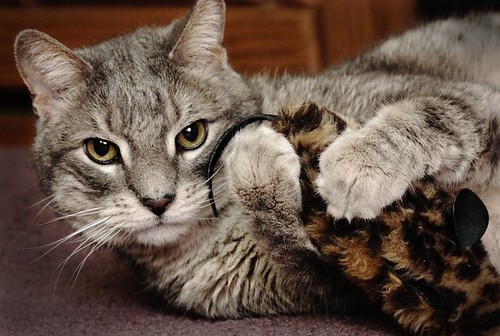
A friend of mine — I’ll call her Dana — has two cats, both indoor, both middle-aged. One of them, a gray tabby named Smoke, had been flagged at his annual checkup as “moderately obese” for two consecutive years. Dana is not a careless person. She feeds premium food. She measured. She just measured loosely, and she let both cats free-feed for the first four years of their lives.
She set up a smart feeder in late January. Her vet had calculated that Smoke should be getting approximately 185 calories per day — about 52 grams of his specific food. The feeder split that into four small meals: 7 a.m., noon, 5 p.m., and 9 p.m.
Week one was rough. Smoke sat in front of the feeder between meals and yelled. Dana almost caved twice. She didn’t. By week three, he had adjusted. By week eight, he had lost 0.6 pounds — which sounds small until you remember that 0.6 pounds on a 14-pound cat is roughly equivalent to a 170-pound person losing 7 pounds.
The imperfect part: the feeder jammed once on a Tuesday morning and dispensed nothing. Dana didn’t notice until she got home at 6 p.m. Smoke had missed three meals. She reached out to the manufacturer, got a replacement part within four days, and now checks the app log every morning before leaving the house — which takes about 12 seconds. Not a deal-breaker. A real thing that happened.
5. What Doesn’t Work — And I’ll Be Specific About It
There are a few approaches to pet feeding that get repeated constantly, and I think most of them are genuinely unhelpful. Here’s my honest read:
- Free-feeding dry kibble “because cats are grazers.” Some cats self-regulate. Many don’t. Indoor cats with low activity and unlimited access to calorie-dense kibble are a recipe for the exact obesity epidemic we’re already seeing. The “they’ll stop when they’re full” assumption has not held up in practice for a large portion of domestic cats.
- Switching to wet food as a complete fix. Wet food can be part of a better feeding strategy, but it still needs to be portioned. A 3-ounce can of cat food ranges from about 70 to 120 calories depending on the formula. Giving two cans a day without checking the calorie content isn’t a solution — it’s the same measuring cup problem with a pull-tab lid.
- Relying on the bag’s feeding guidelines as your baseline. Pet food manufacturers set those numbers to be broadly applicable and — let’s be honest — to move product. The guidelines almost always skew high. Your vet’s calculation will almost always come in lower than the bag recommends.
- Buying a smart feeder and not calibrating it with a vet. This is the one I see most often. People buy the device, enter their dog’s breed and weight into the app, and trust whatever number comes back. That number might be fine. It might be 30% too high. Without a vet-confirmed calorie target, the feeder is just an expensive timer.
6. The Privacy and App Dependency Question Worth Asking
One thing that doesn’t come up enough: smart feeders require an app, and that app requires a working Wi-Fi connection and an active account with the manufacturer. If that company discontinues the product line or shuts down its servers — which has happened in the smart home space more than once — you may be left with a device that still dispenses food on a basic schedule but loses its precision logging and remote control features.
This isn’t a reason to avoid smart feeders. It’s a reason to buy from a company with a track record and to keep a manual backup option in your cabinet. A simple battery-operated timer feeder as a backup costs under $30 and takes 10 minutes to set up. If your smart feeder goes down on a Wednesday and your pet’s next meal is at noon, you want a plan that doesn’t involve driving home from work.
7. Three Small Things You Can Do This Week
You don’t need to buy anything today. Start here:
Step one: At your pet’s next meal, actually weigh what you’re currently feeding using a kitchen scale — not a measuring cup. Write down the gram amount. Then look up the calorie content per 100 grams on your pet food brand’s website. Do the math. Compare that number to your vet’s recommended daily intake. That gap is your baseline problem, or proof that you’re already doing fine.
Step two: At your next vet visit — or call ahead and ask — request a specific calorie target for your pet based on their current weight and activity level. Most practices will give you this number. It’s the number that should go into any feeder, smart or otherwise.
Step three: If you’re considering a smart feeder, look for one with gram-based dispensing (not volume-based), a portion log you can export or screenshot, and a Wi-Fi-independent backup mode. Read reviews from people who’ve used it for more than six months — not just unboxing impressions. The jam Dana experienced on that Tuesday morning shows up in long-term reviews. It doesn’t show up in the first week.
Biscuit, the golden retriever from the beginning of this piece, is now on a measured feeding plan — not a smart feeder, just a kitchen scale and a vet-confirmed gram target. He’s lost 4 pounds in five months. His owner told me last week that he moves differently. “Like he remembered he used to be lighter,” she said. That’s not a technology story. That’s a precision story. The feeder is just the tool that makes precision possible without requiring a perfect human on the other end of the measuring cup every single morning.


Publicar comentário